

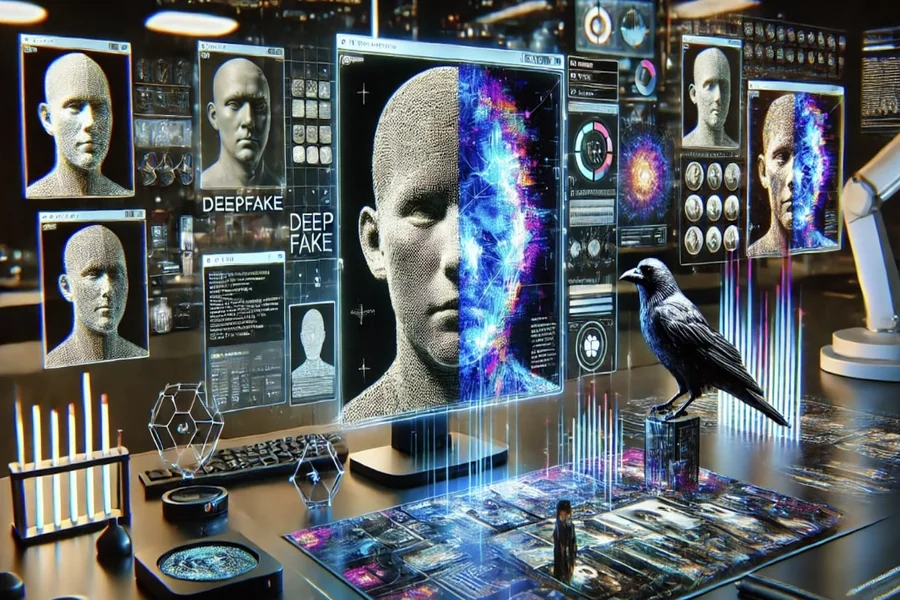
The digital age has entered an era where seeing is no longer believing. As generative artificial intelligence continues to evolve at a breakneck pace, the line between authentic reality and synthetically manufactured media has blurred. We have moved beyond simple photo manipulation into the realm of deepfakes hyper-realistic videos, images, and audio clips created using deep learning algorithms. While this technology offers creative potential in cinema and gaming, its capacity for misuse in disinformation, financial fraud, and personal defamation is unprecedented.
To combat this, a new technological frontier has emerged: Deepfake Detection and AI-Generated Media Verification. This field is dedicated to developing the tools necessary to restore trust in our digital interactions.
Understanding the Anatomy of a Deepfake
Before diving into detection, it is essential to understand the “adversary.” Deepfakes are primarily created using Generative Adversarial Networks (GANs). A GAN consists of two neural networks: the “Generator,” which creates the fake media, and the “Discriminator,” which tries to determine if the media is real or fake. As these two networks compete, the Generator becomes increasingly adept at creating media that can fool even the most discerning eye.
Common types of AI-generated media include:
- Face Swaps: Replacing one person’s face with another’s in a video.
- Lip-Syncing: Manipulating a person’s mouth to match a different audio track.
- Attribute Manipulation: Changing a person’s hair color, age, or expression.
- Voice Cloning: Synthesizing a person’s voice to say things they never uttered.
The Mechanisms of Deepfake Detection
Deepfake detection is a cat-and-mouse game. As generation techniques improve, detection methods must become more sophisticated. Current detection strategies generally fall into three categories: biological inconsistencies, digital artifacts, and metadata/provenance tracking.
1. Identifying Biological Inconsistencies
Early deepfakes often struggled with replicating subtle human biological functions. Detectors are trained to look for:
- Blinking Patterns: Humans blink in a specific rhythmic pattern. Early AI models often failed to replicate this, resulting in subjects who blinked too little or too frequently.
- Pulse Detection (Photoplethysmography): Real skin changes color slightly as blood pumps through the face. Advanced AI detectors can pick up these microscopic shifts in pixel color that are absent in synthetic videos.
- Eye Reflection and Geometry: In a real photo, the reflection of light in the eyes should be consistent across both pupils. AI often struggles with the physics of light, leading to mismatched reflections.
2. Spotting Digital Artifacts
Generative models often leave “digital fingerprints” that are invisible to the naked eye but obvious to an algorithm.
- Frequency Analysis: Using Fourier transforms, researchers can identify high-frequency noise patterns that are unique to GAN-generated images.
- Boundary Analysis: Often, the edges where a “swapped” face meets the original head show slight blurring or pixel inconsistencies.
- Consistency Checks: In a video, a deepfake might have “jitter” where the synthetic mask fails to track the underlying movement perfectly across frames.
3. Metadata and Provenance
Rather than just looking at the pixels, some experts argue we should look at the “birth certificate” of the media. This involves:
- Digital Watermarking: Embedding invisible data into media at the moment of creation.
- Blockchain Verification: Using decentralized ledgers to track the history of a file from the camera to the screen, ensuring it hasn’t been altered.
For those looking to protect themselves or their organizations, using a dedicated deepfake detector is becoming an essential part of the modern digital toolkit. These platforms leverage the latest in machine learning to provide a probability score of whether a piece of media is authentic or synthetic.
The Role of AI-Generated Media Verification
Verification is broader than detection. While detection asks, “Is this fake?”, verification asks, “Where did this come from, and is it what it claims to be?”
The Coalition for Content Provenance and Authenticity (C2PA) is a major industry standard aimed at this. By creating open standards for “content credentials,” platforms like Adobe and Microsoft are helping users see the edit history of an image. If a photo was taken on an iPhone and then edited in Photoshop, the metadata—secured by cryptography—will show those steps. If that chain of custody is broken, the media is flagged as unverified.
Challenges in the War Against Deception
Despite the progress, the challenges are immense.
- The Arms Race: Every time a new detection method is published, AI developers can use that information to train their GANs to bypass the detector. It is a continuous cycle of innovation.
- The Speed of Social Media: Deepfakes can go viral in minutes. Even if a detector identifies a video as fake within an hour, the damage to a person’s reputation or a nation’s political stability may already be done.
- The “Liar’s Dividend”: This is a secondary danger of deepfakes. As the public becomes aware that any video could be fake, bad actors can claim that real evidence of their wrongdoing is actually a deepfake. This erodes the very concept of objective truth.
The Future: Multi-Modal Detection
The future of this technology lies in “multi-modal” detection. Instead of just looking at the video, systems will simultaneously analyze the audio for synthetic signatures and check the context of the metadata. For example, if a video claims to be from a live protest in London, but the shadows in the video don’t match the sun’s position at that time and date, the system will flag a discrepancy.
FAQs: Deepfake Detection and AI Media
Can I spot a deepfake with the naked eye?
It is becoming increasingly difficult. While you can sometimes spot “glitches” (like weirdly shaped teeth or mismatched earrings), high-end deepfakes are virtually indistinguishable to humans. Professional detection software is usually required for certainty.
Are deepfakes illegal?
Legality varies by jurisdiction. Many regions are currently passing laws against “non-consensual intimate imagery” (deepfake pornography) and “election interference.” However, the technology itself is not illegal, as it has legitimate uses in satire and entertainment.
How does a deepfake detector work?
Most detectors use deep learning models (convolutional neural networks) trained on thousands of real and fake videos. They learn to recognize the subtle textures and patterns that differentiate human-recorded media from AI-generated media.
Will blockchain solve the deepfake problem?
Blockchain can help with provenance (knowing where a file came from). If a reputable news organization signs their videos on a blockchain, you can be sure the video hasn’t been tampered with since they published it. However, blockchain cannot stop someone from creating a fake video and uploading it independently.
What is the “Liar’s Dividend”?
A: It is the benefit a dishonest person gains from the existence of deepfakes. Because people know deepfakes exist, a person caught in a real recording can simply say, “That’s an AI-generated fake,” casting doubt on the truth.
Conclusion
The rise of AI-generated media represents one of the most significant challenges to information integrity in human history. As synthetic media becomes more accessible, the potential for both incredible creativity and devastating deception grows.
Deepfake detection and media verification are not just technical “features” they are becoming the essential guardrails of a digital society. By combining biological analysis, digital forensics, and standardized provenance protocols, we can create a landscape where authenticity is verifiable. However, technology is only half the battle. Digital literacy, the ability of the average user to remain skeptical and utilize tools like a deepfake detector will be the ultimate defense in the ongoing war for truth.
